
As many soldiers return as heros from the battlefields of Iraq and Afghanistan, a troubling and saddening phenomenon is occurring. According to a study authored by Dr. Margaret C. Harrell and Nancy Berglass and published through the Center for a New American Security have concluded that one U.S. veteran attempts suicide every 80 minutes. The report also reveals that 1,868 veterans made suicide attempts in 2009 alone. Much of what to make of these staggering numbers is understood through post-traumatic stress disorder (P.T.S.D.) along with the emotions of high unemployment and loss of military camaraderie.
It's not just returning veterans that are attempting suicide, it's also current service personnel. The study goes on to point out that between 2005 to 2010, approximately one service member would attempt suicide every 36 hours. Nearly as many American troops both at home and abroad have committed suicide in 2010 as were killed in combat while fighting in Afghanistan. Many are citing a lack of mental health programs in the U.S. military system, both for current members of the military and as citizens when they come back home.
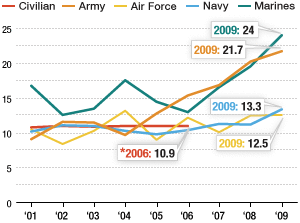
To combat this rising trend, the Pentagon has been implementing new programs targeted at reducing these suicides and to better take care of the needs of military personel. Former military psychiatrist Stephen Zenakis, who is a retired brigadier general believes much more is needed to be done. "There's a whole culture change that would need to occur at the bases here in the United States before we really felt that effect. It may not really be for two to three years until we really recognize that" (NPR).
New evidence from an autopsy of a 27-year old former Marine who committed suicide recently may have shed an important new light on why suicide rates are so high. Doctors performing the autopsy discovered that his brain had been physically changed by a disease called chronic traumatic encephalopathy (C.T.E.), which is a degenerative condition known for affecting boxers, football players, and other athletes who participate in activities that involve repeated blows to the head. People with C.T.E. have an abnormal form of protein that accumulates and eventually destroys cells throughout the brain, including notably, the frontal and temporal lobes. These areas of the brain regulate impulse control, judgement, multitasking, memory, and emotions.
Following on this discovery, doctors performed autopsies on more than a dozen more veterans who committed suicide. They found the same results over and over. This begs the question as Nicholas Kristof writes in his Op-Ed column in the 4/26/12 New York Times, "could blasts from bombs or grenades have a catastrophic impact similar to those of repeated concussions in sports, and could the rash of suicides among young veterans be a result?"
As Kristof points out, because this condition is considered permanent and not able to be cured with therapy, do military families want to here this ominous news? As one military mother states in his article, it is at least a way to know why.
Let's hope that those returning from the battlefield get the proper care they deserve, and bring more attention to the affects of C.T.E. to find ways of reducing its impacts.
Sources:
http://www.dailymail.co.uk/news/article-2057061/One-U-S-veteran-attempts-suicide-80-minutes-Hidden-tragedy-Afghanistan-Iraq-wars.html
http://www.nytimes.com/2012/04/26/opinion/kristof-veterans-and-brain-disease.html
http://www.npr.org/templates/story/story.php?storyId=127860466
UPDATE: Tragically, former New England Patriots Linebacker Junior Seau was found dead this morning after an apparent suicide. It is speculated that Seau suffered from C.T.E. as did former Chicago Bears defensive back Dave Duerson, who also committed suicide on Feb. 17th.
http://www.boston.com/sports/blogs/thebuzz/2012/05/report_junior_s.html
An aggregate of news and interesting topics for debate with an approach to provide opinion and develop ideas for the future.
Showing posts with label Health. Show all posts
Friday, April 27, 2012
Tuesday, April 24, 2012
Possible 'Universal' Cancer Vaccine Developed in Israel
For millions of people around the world affected by cancer, there is some good news coming out of Tel Aviv, Israel this past week. Researchers working on a collaboration project between the drug company Vaxil Biotheraputics and Tel Aviv University have developed a new therapy that targets a molecule found in 90% of all cancers. This therapy, done through a universal injection would allow patient's immune system to fight off common cancers, such as breast and prostate cancer.
Cancer is the leading cause of death worldwide and accounted for 7.6 million deaths (around 13% of total deaths) in 2008 according to the World Health Organization. The types of cancers most affecting people around the world include lung (1.37 m deaths), stomach (736,000), liver (695,000), colorectal (608,000), breast (458,000), and cervical cancer (275,000). A majority of these deaths, 70%, occurred in low and middle income countries, where treatment is less available and of lower quality. By 2030, if the current rate continues, the WHO projects over 13.1 million people will die of cancer worldwide. This new therapy out of Israel could significantly lower these numbers if it successful.

Within the United States, almost 12 million people currently have been diagnosed with a form of cancer as of 2008 according to the American Cancer Society. This total is roughy split between males with 5.5 million and women with 6.5 million patients. The highest prevalence being with breast cancer in women, which constitutes more than a sixth of all cancer patients.
Cancer arrises out of one single cell. Under certain conditions, the cell with undergo a transformation from a normal cell into a tumor cell through a multistage process. This progression from a pre-cancerous lesion to malignant tumor can be the result of the interaction of a person's genetic make up and three major external agents. The external agents being categorized as 1) physical carcinogens, 2) chemical carcinogens, and 3) biological carcinogens. Furthermore, cancer development incidence can rise dramatically with age, and is likely attributable to the build up of risk factors.
For all the environmental and genetic risk factors, and the increasing prevalence of cancer, a discovery of this nature is remarkable. Preliminary results from clinical trails have shown the vaccine can trigger an immune response in patients, subsequently reducing the levels of cancer. Researchers believe the vaccine could be used to combat small tumors if detected early enough and also help prevent the return or spread of disease in patients who have undergone alternative forms of treatment, such as surgery, chemotherapy, or radiation treatment.
![]() |
| Tel Aviv University |
This research is promising and let's hope that with further trials and further research, this vaccine will be able to come to market in the near future.
For more on the topic, please visit the following sources:
American Cancer Society:
http://www.cancer.org/Cancer/CancerBasics/cancer-prevalence
World Health Organization:
http://www.who.int/mediacentre/factsheets/fs297/en/
The Telegraph:
http://www.telegraph.co.uk/science/science-news/9191848/Universal-cancer-vaccine-developed.html
Labels:
Health,
Science,
United States,
World
Location:
Eugene, OR, USA
Sunday, April 15, 2012
A Revealing Look At Food Waste
In our current world's state of affairs, nearly one-third of food goes to waste according to a 2011 United Nations estimate. For one photographer, Klaus Pichler, this has become a passion that has inspired both fantastic displays of photography as well as a new book titled One Third. The new book displays images of food in advanced stages of decay along with speaking tones to which he intends to convey (more of these images can be seen on NPR's link below).
The book brings to image how the U.S. and Europe waste approximately ten times as much food per person as sub-Saharan Africa or Southeast Asia according the the U.N. estimate. (Report can be read by clicking this link) For the developing world, one of the major problems is storage, but unlike their counterparts in the developed world, consumers simply throw away huge amounts of food that are still edible.
Klaus Pichler says "there are lots of spontaneous decisions in the supermarket, people often don't stop to think about whether they're buying too much, or whether they could reuse leftovers instead of throwing them away."
Pichler explains more about his art and the story it tells to NPR's The Salt. The worst he mentioned about his photography process was about raw chicken and octopus decomposing at the same time. He says: "these two smells united, and it was horrible" and he further mentions that over the process it became important for him to "coexist with the rotting food."
For more on this story, visit the attached link below.
Revealing the Revoting Beauty of Food Waste NPR's The Salt
http://www.npr.org/blogs/thesalt/2012/04/14/150494837/revealing-the-revolting-beauty-of-food-waste
Location:
Eugene, OR, USA
Saturday, March 31, 2012
Obesity in The United States
Last month I wrote an article about obesity as a public good (not as a good thing) [link]. In it I talked about how increasing obesity rates are adding significant costs not just for the present, but for America's future.
Yesterday, CNBC published an article that showed that in a recent Gallup poll, 26% of American adults are classified as obese. The overal health-care costs associated with obesity are estimated at $147 billion a year. The measure of obesity is based on the body mass index (BMI), in which a person is classified as obese if they have a score of 30 or higher. Obese people have higher chances of heart disease, diabetes, strokes, some cancers, and other related issues.
The article examined metropolitan areas in the U.S. and was designed to offer better understanding of the perspective of cities affected by obesity. Of the top 10 metro areas with the highest obesity rates, 58% of the residents were more likely to report having a heart attack over the course of their lifetimes, and 34% more likely to report having high blood pressure. Those alone, are estimated to cost over $1 billion in medical costs each year.
Here are the top five cities with the highest obesities rates:
5. Beaumont-Port Arthur, Texas
- Obesity Rate: 33.8%
- Annual Costs: $182.8 million
4. Rockford, Illinois
- Obesity Rate: 35.5%
- Annual Costs: $179.4 million
3. Huntington-Ashland, West Virginia
- Obesity Rate: 36%
- Annual Costs: $146.9 million
2. Binghamton, New York
- Obesity Rate: 37.6%
- Annual Costs: $131.5 million
1. McAllen - Edinburg - Mission, Texas
- Obesity Rate: 38.8%
- Annual Costs: $410.9 million
These costs are staggering. I know from personal experience, weight is easy to gain, but with just slight changes in diet and increased exercise that weight can come off as well. When we look at the static choices of eating unhealthy foods, we really need to consider the dynamic affects of eating unhealthy food. But, let's also understand that while this seems simple, know that for some in this country as the economy as been in recovery mode, affordable healthy options have been limited. Its just one example of the externalities of a changing economy and culture in the United States.
Sources:
http://realestate.yahoo.com/promo/americas-fattest-cities.html
Yesterday, CNBC published an article that showed that in a recent Gallup poll, 26% of American adults are classified as obese. The overal health-care costs associated with obesity are estimated at $147 billion a year. The measure of obesity is based on the body mass index (BMI), in which a person is classified as obese if they have a score of 30 or higher. Obese people have higher chances of heart disease, diabetes, strokes, some cancers, and other related issues.
The article examined metropolitan areas in the U.S. and was designed to offer better understanding of the perspective of cities affected by obesity. Of the top 10 metro areas with the highest obesity rates, 58% of the residents were more likely to report having a heart attack over the course of their lifetimes, and 34% more likely to report having high blood pressure. Those alone, are estimated to cost over $1 billion in medical costs each year.
Here are the top five cities with the highest obesities rates:
5. Beaumont-Port Arthur, Texas
- Obesity Rate: 33.8%
- Annual Costs: $182.8 million
4. Rockford, Illinois
- Obesity Rate: 35.5%
- Annual Costs: $179.4 million
3. Huntington-Ashland, West Virginia
- Obesity Rate: 36%
- Annual Costs: $146.9 million
2. Binghamton, New York
- Obesity Rate: 37.6%
- Annual Costs: $131.5 million
1. McAllen - Edinburg - Mission, Texas
- Obesity Rate: 38.8%
- Annual Costs: $410.9 million
These costs are staggering. I know from personal experience, weight is easy to gain, but with just slight changes in diet and increased exercise that weight can come off as well. When we look at the static choices of eating unhealthy foods, we really need to consider the dynamic affects of eating unhealthy food. But, let's also understand that while this seems simple, know that for some in this country as the economy as been in recovery mode, affordable healthy options have been limited. Its just one example of the externalities of a changing economy and culture in the United States.
Sources:
http://realestate.yahoo.com/promo/americas-fattest-cities.html
Friday, March 30, 2012
Autism on The Rise
This increase shows that there has been a steady increase in diagnosis. A rate that was nearly twice as common as officials estimated it would be just five years ago.
The diagnosis process is made by specialized doctors making judgements about a child's behavior. At no point are blood or biologic tests involved. Diagnosis is given to those who show symptoms of severe language and social impairments, as well as unusual repetitious behavior(s). Genetics is believed to play a role, and CDC researchers are looking to learn about other possible factors such as illnesses that the mother had while pregnant and with medications pregnant women had used.
The CDC used estimated rates from 14 U.S. States to compile their data. States included, Alabama, Arizona, Arkansas, Colorado, Florida, Georgia, Maryland, Missouri, New Jersey, North Carolina, Pennsylvania, South Carolina, Utah, and Wisconsin. Within these states, Alabama demonstrated the fewest number of diagnosis, with one in 210 children, some of this being attributed to low available amounts of information. The highest states were Utah with one in 47 and New Jersey also showed a high rate of 1 in 49. Dr. Eric Fombonne, a psychiatrist at McGill University and Montreal Children's Hospital said in the NY Times that "it means that ascertainment is unequal across states."
The diagnosis is far more prominent in young boys before the age of 8. Boy were almost five times as likely to be diagnosed as girls. Boys are at a rate of one in 54 and girls are one in 252 for girls.
As many from the CDC have pointed out, Autism incidents are increasing. Whatever the causes, this disorder is posing further challenges for health care and our future. A careful eye on Autism is a wise position to take.
http://www.nytimes.com/2012/03/30/health/rate-of-autism-diagnoses-has-climbed-study-finds.html?_r=1
http://finance.yahoo.com/news/autism-rates-screening-better-diagnosis-164651100.html
Labels:
Health,
Science,
United States
Location:
Lake Oswego, OR, USA
Wednesday, February 22, 2012
Food Stamps in the United States
Food Stamps in America
![]() |
| Food Stamp money is now distributed with a Benefit Security Card |
Often we pay too much attention to the macro developments of our recovering economy, but for millions of Americans the past few years have been a struggle and continue to be. One program that is often criticized by pundits is the Food Stamp program. Despite the criticism, the fact remains that millions of Americans depend on food stamps in order to survive and feed their children.
In the past decade, the number of people who have applied for and now receive food stamps has surged. Under President Bush, the number grew by 15 million persons, and in the past four years of Obama, an additional 14 million people have been added to the program. With this surge, the total amount of people receiving food stamps has risen to 46 million people.
Within these 46 million people, approximately a third are white, a fourth black, and a sixth hispanic, the rest are unknown. In order to qualify for food stamps, a single person must earn less than $14,000 in income and for a family of four, less than $29,000. The exact amounts of benefits depend on what income level an applicant is at, and in some states their cash assets.
Many experts attribute this dramatic rise in the demand for food stamps to the increasing level of Americans below the federal poverty line. According to U.S. Census Bureau data, 85% of households receiving food stamps are below the poverty line.
Additionally, the number of persons employed receiving food stamps has also risen to 40%. Some of these people are employed, but unable to receive forty hour work weeks, and earn their state's minimum wage or slightly above. Today, employed households outnumber families who are unemployed on food stamps. Much of this rise is attributable to the rising costs of utilities, food, health care, and other living costs.
Living in this situation is very stressful for families, and their ability to feed their children nutritious food has been diminish with their inability to purchase the more expensive healthier options, even while under the program. This is building a cost and burden not only in the current, but in the long run.
Critics of the program claim that these families need to work harder and also claim that fraud is a major cause of the lack of funding. This is, however, against what the Government Accountability Office estimates as a plunge in fraud to a rate of below 1%.
In the richest nation on Earth, it is inexcusable that these rates have grown and have not been diminished. These are our own citizens and their children are our future. Children who are malnourished lowers their ability to develop, and potential for the future. Not only should our nation focus more on our own people, but we should increase our attention of those in the poverty range. A strong America does not mean that a few are strong, it means that all Americans be strong, no matter if one earns a million dollar salary or just above the poverty line.
I encourage you contact your local representatives and encourage them to not only highlight the macro improvements of our economy, but the remaining micro situations that every day Americans live in.
For a touching video about Food Stamps in America, visit this PBS video: http://video.pbs.org/video/2198222432
Additionally, you can learn more about the facts of food stamps at the Social Security Administration website:
Labels:
Economy,
Health,
United States
Location:
Eugene, OR, USA
Thursday, February 16, 2012
Obesity as a Public Good?
![]() |
| The "Triple Bypass Burger" |
This story is something I'd be more likely to be seeing in The Onion, the online satire news service. But what it really points out is just one example of an anecdotal story to how some people choose to risk their health, when the warning signs are blatantly in front of them. Of course eating a cheeseburger a few times isn't a horrible thing, but when a person attempts to intentionally sabotage their health, it gets a bit scary.
![]() |
| The "Nurses" of the Heart Attack Grill |
Because of these huge costs that are imposed through externalities of these types of foods and that really the only person deciding is the consumer himself, what is governments role in this type of policy? Should the government have a role at all?
![]() |
| A "Taste Worth Dying For" |
What are your solutions? Share you thoughts in the comments section below.
Subscribe to:
Posts (Atom)