Showing posts with label Economy. Show all posts

Friday, April 27, 2012

Higher Education In America: Special Series

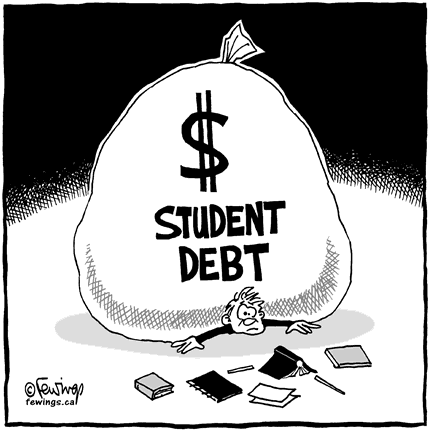
Over the next few weeks, I will be producing a series of blog posts about the state of the higher education system in United States. Prompted by my soon to be graduation (fall 2012) and a sign on the campus of the University of Oregon that stated "College Debt Reaches 1,000,000,000,000" (yes, that is 1 trillion), I have decided to look into just what is the student debt in America, what does it mean for our future, and what will need to happen to make these issues less of a burden in the future.

I will also be researching and writing about financial aid, how education pays off, and the pricing / cost of attending college. In addition, I will be looking at and blogging about a study I received from a mentoring economics professor here at the U of O about the costs of skipping classes.

I personally have invested interest in this topic being a current student, even without college debt (thanks to my parents), but I think it's really an issue that has many more affects than just for students and their families. Affects are present in our federal and state budgets, personal wealth, overal competitiveness as a 21st century nation among many others.


Stay tuned for more posts and if you have any thoughts or comments about the subject, or a personal anecdote about your college experience, please drop a comment.

Sunday, April 22, 2012

1 in 2 New College Graduates are Jobless or Underemployed

As college seniors come into spring, many of us are preparing to graduate. As we do, we will be facing a weak labor market that could make finding a job of our dreams really difficult. About 1.5 million or 53.6% of graduates under the age of 25 were jobless or underemployed in 2011. This was the highest rate in more than a decade. Going back to the year 2000, this rate was just 41%.

Many college graduates are increasingly turning to lower-wage jobs such as waitering, bar-tending, retail; jobs that do not utilize the investment of four years or more of higher education. This is confounded by higher tuition and the increasing levels of student loans. According to Harvard economist Richard Freeman, student loan debt has surpassed $1 trillion.

While their knowledge and abilities are important to our society, demand for the arts and humanities have simply not been producing any form of market for jobs. This is contrasted with high demand from employers in science, education, and health care. Even within those categories, specific positions and majors vary on demand.

A lot of the decrease in demand for college graduates is attributed to technological changes and the macro economic downturn of recent years. By region, the hardest areas to find jobs were in Mountain West, where about 3 in 5 graduates are underemployed or jobless. Following in their footsteps were Southern states Alabama, Kentucky, Mississippi, and Tennessee, along with Pacific region states Alaska, California, Hawaii, Oregon, and Washington. On the opposite end, Texas demonstrated strong higher skilled jobs among graduates attributed to clusters in high tech industries.

The middle level workers seem to be the worse hit, with job gains coming from top and bottom of the wage scale. Up to 95% of positions lost during the economic recovery occurred in middle-income occupations.

This poses a serious problem as college graduates are fresh out of college, with their skills at hand only to be faced with the burden of losing that competitive edge to future generations of college graduates. It's an affect that hampers the economy today and in the near future.

It is said the most successful people find what they are good at, and stick with that career path through the thick and thin, but at this point, just how thin can we go before we starve?

Source: http://finance.yahoo.com/news/1-2-graduates-jobless-underemployed-140300522.html


Tuesday, April 17, 2012

Gender Wage Gap in America

Following a report by the Institute for Women's Policy Research, the Economist published an article today illustrating the affect of the gender wage gap in America. To this day, women still earn significantly less than men in almost all forms of occupations.


In the previous year, 2011, full-time working women in America earned just 82.2% of the male median weekly earnings. This phenomenon was common across almost all occupations, only subtracting the fields of "stock clerks and order fillers" and "bookkeeping, accounting, and auditing clerks" where women made just slightly more than their male counterpart.

The gender wage gap is developed as a percentage of earnings women have against those of males. The gap was most obvious in CEOs and financial managers where female executives earned just 69% of what male's earned. In total this was nearly $658 less in median weekly earnings.

For more visit the Economist online: http://www.economist.com/blogs/graphicdetail/2012/04/focus-3?fsrc=scn/fb/wl/bl/americasgenderwagegap

Monday, April 16, 2012

The Existence of The Penny


I am willing to bet you have a few pieces of change in your pocket rattling around as you walk down the street. I will also bet you'll be pretty likely to have a few pennies in there causing that ruckus. But here's the question: how often do those pennies make it out of your pocket to no long be noise makers, and actually go towards purchasing anything? Further, how many of those pennies are just wasted money, either lost or never used?

I doubt its very often. The only time I can actually remember someone paying or using pennies was in this Seinfeld episode where Kramer tries to pay for Calzones in pennies.


There have been many calls for the U.S. Government to dispand the penny. Up north in Canada the calls have been heard. The penny will soon be out of circulation. Due to rising prices of the metals the penny is made of in Canada, it actually costs 1.6 cents to produce the 1 cent penny, a loss of .6 cents. The cost and output is nearly identical back here in the United States. In total the Canadian Government claims to lose nearly $11 million a year producing and distributing the penny, not to mention the costs borne onto business and consumers who deal with pennies.

A 2008 report by a Quebec based bank, Desjardins, suggests the penny's existence had cost the Canadian economy nearly $150 million for year 2006. For example, Canada's big banks handle more than 9 billion pennies a year, which in amount to $20 million annually for processing.

The Bank of Canada also concluded in a 2005 study, that the pennies disbandment would not lead to any showings of inflation. This concept also cites the past examples of Norway, Australia, and New Zealand along with other nations who have not seen any systemic price increases.

Nevertheless, we still have our old friend, the penny. So what do you think? Should the penny stay?


For more:
http://www.freakonomics.com/2012/03/30/canada-kills-its-penny-can-we-please-be-next/

Friday, April 13, 2012

What Americans Pay in Taxes

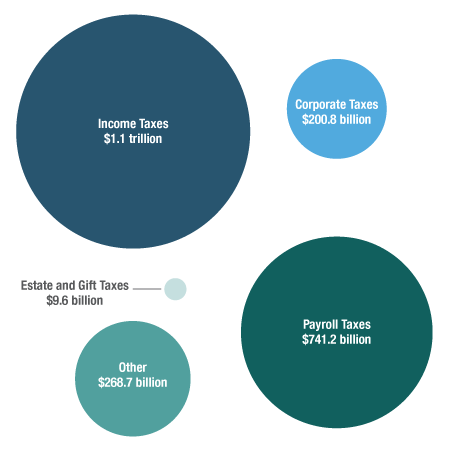
Last year, 2011, the federal government collected a total of $2.3 trillion in taxes. The majority of this was made up of by two sources, income tax which accounted for $1.1 trillion and payroll taxes, which accounted for $741.2 billion.

The graphic below (courtesy of NPR's Planet Money) displays the breakdown and extents of each of the respective taxes. The other forms of taxes are composed of corporate taxes ($200.8 billion), estate and gift taxes ($9.6 billion) and other forms ($268.7 billion).


What Taxes Go Towards:

The grand old question, but here are some basics on where each of these subsets of taxes go. Payroll taxes are deducted automatically from a person's paycheck, paid in part by employers and fund Social Security and Medicare. Individual income taxes pay for most of what the government does other than Social Security and Medicare. Other taxes such as estate taxes come from large inheritances, corporate tax paid by corporations, and the others category include customs duties, excise taxes on products (gasoline and the like).

How Much Do Americans Pay:

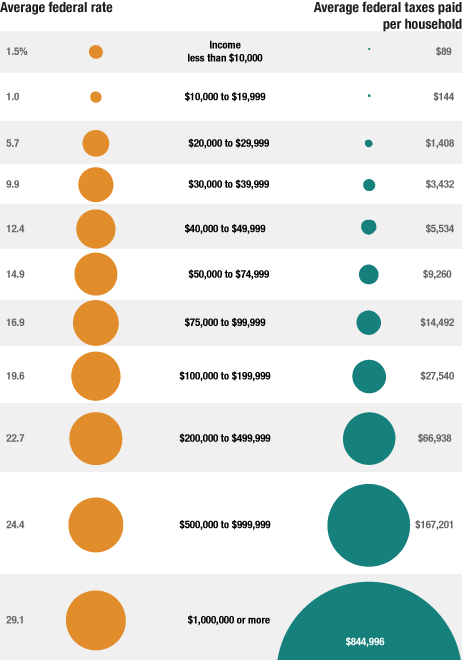
Below is a graphic that explains the average federal rate and average federal taxes paid per household for each income bracket.


For more on the subject, visit NPR's Planet Money blog:
http://www.npr.org/blogs/money/2012/04/13/150441259/what-america-pays-in-taxes


Thursday, April 5, 2012

What the Average American Consumes

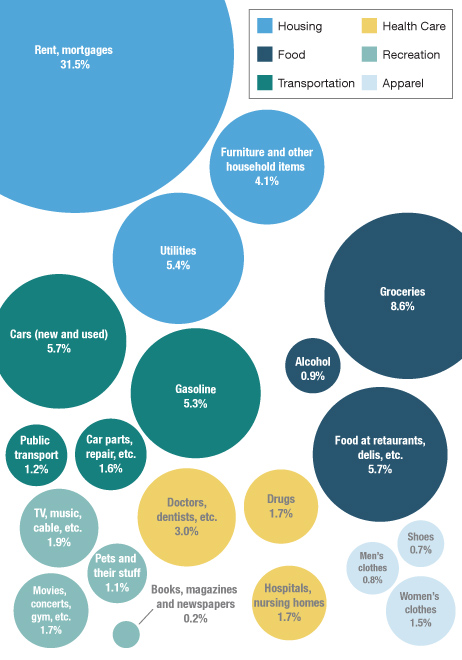
NPR's Planet Money program used data collected by the Bureau of Labor Statistics to break down what the average American buys. The data was part of CPI Detailed Report for December 2011. The figure below is from this report (it can be found on the below link) and it details up to approximately 93% of what Americans use their incomes for. From what I can discern, this is after taxes disposable income. Keep in mind also, this is just average, it won't necessarily be what you spend.

Here's a few big expenditures:

Rent/Mortgages: 31.5%
Groceries: 8.6%
Food at Restaurants, delis, etc: 5.7%
Cars (new & used): 5.7%
Doctors, Dentists, etc: 3%

Some interesting ones:

TV, Music, Cable, etc: 1.9%
Movies, concerts, gym, etc: 1.7%
Books, Magazines, Newspapers: 0.2%
Pets and their associated goods: 1.1%
Shoes: 0.7%
Women's Clothing: 1.5%
Men's Clothing: 0.8%


Note: I find it rather interesting first of all that Americans spend significantly more on shoes than on all books, magazines, and newspapers. Furthermore, this gives a bit more notice to how there is a significant shift in America from the old form of physical media to more electronic media (music, TV, etc).

Also, as can be expected, women spend far more on clothes than men, almost twice as much in fact.

Many commenters on the article noted that healthcare should be far higher. I assumed it would be, but then I realized the aspect of averages (youth tend to spend less on healthcare than older generations), and thus this being the case, possibly that is a "low-researched" answer.

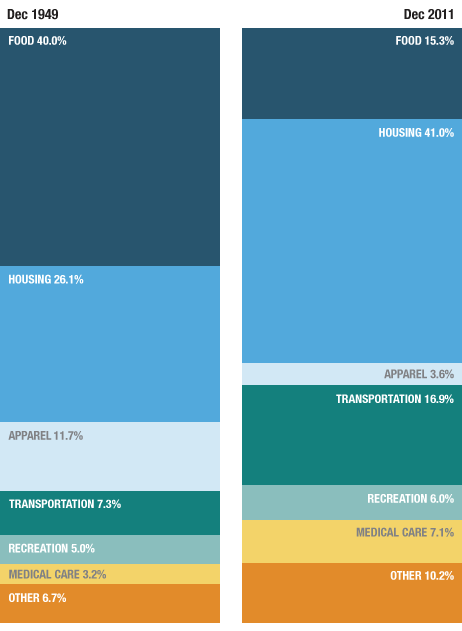
Comparing 1949 to 2011: 

American's spend far less on food today as they did 62 years ago, almost 25% less in fact. There has almost been a complete switch in expenditure in housing expenses and food during this period as well. Transportation has risen, along with health care, but notably, apparel has decreased significantly ( maybe higher quantities of low cost clothes [Old Navy]?).


What do you think you spend your money on?

For more visit NPR's Planet Money page:


 http://www.npr.org/blogs/money/2012/04/05/149997097/what-americans-buy

Saturday, March 31, 2012

African Democracy

Today, all but one African nation holds elections, the remaining being Eritrea. However, African democracy does not always produce representative governments. The Economist Intelligence Unit's annual democracy index ranks only one African country, Mauritius, as a full democracy. Their criteria is rather tough however, even classifying the very well praised Botswana as a flawed democracies.

A quantitative measure of good governance, called the Mo Ibrahim Index, shows that there is a decline of 5% since 2007 in African political participation. According to the think tank, Freedom House, the number of full electoral democracies among the 49 sub-Saharan countries has falled from 24 in 2005 to 19 as of today.

This does not mean Africa has not come a long way. In 1990, Freedom House had listed just three African countries with multiparty political systems, universal suffrage, regular fraud-free elections, and secret ballots. Reformers also have plenty of reasons to be hopeful. Growing sophistication of opposition groups have become less of a mess, divided, undemocratic, and starved of resources.

Impressive economic growth rates in many African countries have fueled a communications explosion. Political campaigns no longer need or depend on government-owned media or the ability to travel to distant villages. They are able to reach more young voters and capture the desire for political freedoms.

Let's hope this wave of democracy and political freedoms continue to grow in Africa.

For more on this: http://www.economist.com/node/21551494?fsrc=scn/fb/wl/ar/glasshalffull

Thursday, March 15, 2012

Positive Signs In The U.S. Economy

Tying a four-year low, fewer people sought unemployment benefits this past week of March. This has added confidence the job-market is showing signs of growth and strengthening. Applications for unemployment aid were down 14,000 to a seasonally-adjusted 351,000 according to a report released by the Labor Department. This has been a positive trend over the past six months as the average has declined 14% since October 2011.

Following this steady decline in unemployment benefits, employers have added an average 245,000 jobs a month between December and February. This amounts to the best three months of hiring in the past two years. The unemployment rate has also declined to 8.3%, the lowest in the past three years. This trend is expected to follow for March, with an additional 200,000+ jobs being added. This indicates the labor market is steadily growing, slowly indeed, but improving none the less.

February's rise in gas prices did drive U.S. wholesale prices up last month, but excluding this, inflation did not change significantly. The producer price index rose 0.4% and the core index (which excludes food and gas prices) increased 0.2%. In the past year, wholesale prices have increased 3.3%, and this represents the smallest year-over-year gain since August 2010.

All things considered, the job growth is driven by a stronger economy, which grew at an annual rate of 3% in the last three months of 2011. Consumers show more confidence and have added additional spending to the market. Auto sales and the stock market have both shown positive growth over this same period.

Manufacturing has also expanded in February. Manufacturing conditions rose in March to 12.5 on the index of manufacturing conditions, a measure used by the Federal Reserve Bank to measure the strength of the manufacturing sector. The Labor Dept. reports that in the last week of February, manufacturing jobs have grew by 31,000, and over the past year, jobs had increased by 227,000.

While these signs of growth are during an election year and the U.S. economy is still on a long path to full recovery since the 2007 recession began, these positive signs re-enforce my view America is back on the right track.

Sources: AP.

http://www.google.com/hostednews/ap/article/ALeqM5hWdSXd8-vuWc0f14K6w4cW5iAqyw?docId=d1017724a4be4014934f945248bc1fe9

http://www.google.com/hostednews/ap/article/ALeqM5izcL8QJnJ9nKdqi3U_pQTqh4JZTA?docId=ee0f8ae4921341669a1002e60ab269f5


Friday, March 2, 2012

Neil deGrasse Tyson Warns of the Costs of Cutting NASA

Neil deGrasse Tyson elements exactly what types of positive externalities come out of funding NASA. Currently we fund NASA half a penny for every tax dollar collected. Tyson suggests that a doubling of the funding of NASA to just 1 penny for every tax dollar would change the culture of a nation. I agree. In economics, reference the Romer Model. Furthering on the Solow Model, a landmark model in macroeconomics, Romer pointed to technology being not only the determinant of growth, which Solow suggested, but that the function of technology growth is based upon the population of a nation, the percentage of people focused on research, and then the direct improvements based upon that technology.

Positive macroeconomic growth in the nation is based on a shift in focus from just short run growth with sales, to making the investment in research for tomorrow. I agree 100% with Neil deGrasse Tyson, and I disagree with the trend of defunding NASA that President Obama is continuing. If our future generations are to compete, NASA, education, and infrastructure are what we need to focus on. Give a free market the tools to succeed, and let this nation bloom, that is a strong government mindset.

Watch the interview with Neil deGrasse Tyson on Fox Business:
http://video.foxbusiness.com/v/1483676909001/the-costs-of-cutting-nasas-budget/


Wednesday, February 22, 2012

Food Stamps in the United States


Food Stamps in America

Food Stamp money is now distributed with a Benefit Security Card
Often we pay too much attention to the macro developments of our recovering economy, but for millions of Americans the past few years have been a struggle and continue to be. One program that is often criticized by pundits is the Food Stamp program. Despite the criticism, the fact remains that millions of Americans depend on food stamps in order to survive and feed their children.  

In the past decade, the number of people who have applied for and now receive food stamps has surged. Under President Bush, the number grew by 15 million persons, and in the past four years of Obama, an additional 14 million people have been added to the program. With this surge, the total amount of people receiving food stamps has risen to 46 million people. 

Within these 46 million people, approximately a third are white, a fourth black, and a sixth hispanic, the rest are unknown. In order to qualify for food stamps, a single person must earn less than $14,000 in income and for a family of four, less than $29,000. The exact amounts of benefits depend on what income level an applicant is at, and in some states their cash assets. 

Many experts attribute this dramatic rise in the demand for food stamps to the increasing level of Americans below the federal poverty line. According to U.S. Census Bureau data, 85% of households receiving food stamps are below the poverty line. 

Additionally, the number of persons employed receiving food stamps has also risen to 40%. Some of these people are employed, but unable to receive forty hour work weeks, and earn their state's minimum wage or slightly above. Today, employed households outnumber families who are unemployed on food stamps. Much of this rise is attributable to the rising costs of utilities, food, health care, and other living costs. 

Living in this situation is very stressful for families, and their ability to feed their children nutritious food has been diminish with their inability to purchase the more expensive healthier options, even while under the program. This is building a cost and burden not only in the current, but in the long run. 

Critics of the program claim that these families need to work harder and also claim that fraud is a major cause of the lack of funding. This is, however, against what the Government Accountability Office estimates as a plunge in fraud to a rate of below 1%. 

In the richest nation on Earth, it is inexcusable that these rates have grown and have not been diminished. These are our own citizens and their children are our future. Children who are malnourished lowers their ability to develop, and potential for the future. Not only should our nation focus more on our own people, but we should increase our attention of those in the poverty range. A strong America does not mean that a few are strong, it means that all Americans be strong, no matter if one earns a million dollar salary or just above the poverty line. 

I encourage you contact your local representatives and encourage them to not only highlight the macro improvements of our economy, but the remaining micro situations that every day Americans live in. 


For a touching video about Food Stamps in America, visit this PBS video: http://video.pbs.org/video/2198222432
Additionally, you can learn more about the facts of food stamps at the Social Security Administration website

Tuesday, February 21, 2012

China's Economy Is Growing, But is it Sustainable?

NPR's Planet Money travels to China for an in-depth investigation into China's economy. It's a fascinating debate, are the Chinese building too fast, or are they potentially adding substantial debt in the current all to be counteracted by a future benefit of the Chinese economic machine?

Take a listen:

Thursday, February 16, 2012

America Is Back

Despite our political season this year, despite all the blame being spread around, the stress of our economy, and the continuance of politicians trying to install fear into us all for a vote, Americans have shown we are not tolerating this, and we will not stand for this. Sure, we have many challenges ahead, and the road ahead is not going to be easy, but we are prepared to take that road and as Clint Eastwood proclaimed in his Chrysler sponsored Super Bowl ad, "this country doesn't go down with one punch, we get right back up, and when we do, the world will hear the roar of our engines."

That roar is beginning to rev up in America. Don't let this time of political discord and blame stop us, or even slow us down for one second. Remember who we are, and instead of touting our adversity as what we relish on, start to relish on the fact that American jobs are returning, American manufacturing companies are starting to onshore back to our soil, and that given our renewed respect around the world, we stand to have a much brighter future than one where we simply wallow on where we fall short. 

This country is a great one, and yes we have many challenges to come. But I never knew a challenge to be solved by simply complaining and being scared about it. The only way to solve a problem is to do something about it and we are starting to do something, and when we get started, there is nothing that can stop us when we are united under one common goal. 

I love this country, and even though I have strong disagreements with some candidate's positions, I love that we are able to have such disagreements. Let us just remember, those disagreements should only be made if they are to push us forward and not pull us backward into abyss. So if you are a member of the Republican or Democratic party, remember you are only just a member of that party, but that your other members and those members of a different shade of color, we are all citizens of the United States, and we are all Americans. 

Here's to a bright future ahead America. 

Tuesday, February 14, 2012

Can't Buy Me Love? Oh Really?


In 1964, the Beatles said "I don't care too much for money, money can't buy me love" in the infamous hit "Can't Buy Me Love". Well maybe that's not so much the case in America. On average, Americans spent about $116 on Valentines Day last year. This had been a rise from the sudden drop to $68 in 2010, but otherwise considered normal when compared to the previous two years, $102 in 2009, and $128 in 2008. This shows that most Americans spend about the same no matter what the economic conditions, and according the H&R Block, U.S. men spend nearly twice as much on Valentines day than U.S. women. It is also expected that this amount will grow about 8% in 2012 to nearly $200. So guys, hopefully you've been saving your nickels and dimes up since Christmas every time you get your morning Starbucks to get your lucky lady something nice. 

Some big gifts are cards, flowers, candy, and jewelry. These heavy hitters account for quite a lot of the money spent. Alone, jewelry accounts for $4.1 billion, diamonds really are a girls best friend. On average, about 18.9% of Americans will buy these fancy jewels and then will likely give these gifts while spending a night out that adds up to $3.5 billion at restaurants. In total, about $17.6 billion will be spent this Valentine's day. 

All in all, Valentine's Day is great day to spend with your loved one and gifts are just one of many ways to show someone you care. Still, you can't buy love, but all you do need is love.. Wishing all those who have a special someone a happy Valentine's Day, and for those who are single, that they find the love of their life soon!

One more thing, guys follow this link to

http://www.youtube.com/watch?v=uWrJgFjxlS0 where Adriana Lima has a message for you. 


Sources:

Infographic: 
http://blogs.hrblock.com/2012/02/07/valentines-day-spending-infographic/

Sunday, August 21, 2011

Class Warfare and Jon Stewart as the Crusader

In Thursday night's episode of The Daily Show, Jon Stewart did more to defend the poor and disadvantaged than you will ever see out of Obama, Bachman, Perry, or any politician. Stewart, not one to ever stick his nose in business no one in power wants him to be, put his commentary in the first half of the show.

Check it out: http://www.hulu.com/watch/269517/the-daily-show-with-jon-stewart-thu-aug-18-2011#s-p1-so-i0

Sunday, August 7, 2011

Standard & Poor Lays a Smack-down to U.S. Government

Wall Street had of its worst weeks, losing nearly all gains in 2011. 
As many of you have probably already heard about, Standard and Poor (S&P) has downgraded the U.S. credit rating from the highest rating of AAA to a AA+ rating this past Friday. This is the first time the United States has faced a downgrade and it has sent tidal waves throughout the financial market. Given that Europe is suffering major levels of adversity with Greece possibly heading for a default just months after it receive a major bailout by the IMF, and with unemployment in Spain for youth at nearly 46%, this is just another piece of bad news for the Western World. China, the United State's largest creditor was quick to criticize the United States, saying that "the U.S. government has to come to terms with the painful fact that the good old days when it could just borrow its way out of messes of its own making are finally gone," this according to an official Chinese news agency. (For more click here) Additionally this rating drop only fuels the international debate for a change in base currency from the dollar. These may be the signs that the fall of U.S. hegemony is coming faster than we thought and possibly China's surge may quickly take over the financial leadership of the world. Of course, they have problems of their own, which is a story for a later time. 


Now, who is to blame for this debacle we are in? Keeping in mind there is no single entity. One very important agency in the financial sector has an opinion. In an interview with CNN's Anderson Cooper last night, John Chambers the Chairman of S&P's Committee on Sovereign Nation Ratings quietly, and in a very calm demeanor delivered some harsh criticism of U.S. policy makers (watch interview here). Chambers is a very technical and calm man, not much of a T.V. personality type, and if there were any doubts about what he was saying with his tone, they were immediately cleared up by the official memorandum released by S&P (read the document here). Here is quote from the rational section of the memo: "the political brinksmanship of recent months highlights what we see as America's governance and policymaking becoming less stable, less effective, and less predictable than what we previously believed." Not to lay any more criticism, but it is followed by "our (S&P) opinion is that elected officials remain wary of tackling the structural issues required to effectively address the rising U.S. public debt burden in a manner consistent with a 'AAA' rating." Ouch, for a very technical document, made by guys that have many friends in Washington and on Wall Street, those are some direct and stinging words. The thing about it, S&P couldn't be any closer to the truth. 


This really has become a major wake up call for the U.S. Government. So while they are on summer holiday, they really need to be managing their constituent bases, communicating with each other, and finding the correct policy to align this nation out of this momentous hole we have dug ourselves into. Now, that is unlikely to happen. Grudges don't die easily in Washington and with the 2012 election year ramping up, the pundits on both sides fueling the fire, I can only hope that we as a nation are better at the end of the day, and not just the political career of some so called representative. 


Tuesday, August 2, 2011

The U.S. as a Parasite to the Global Economy?

At a Pro-Kremlin youth group the other day, Russian Prime Minister Vladimir Putin accused the United States as being "like a parasite" to the global economy. Adding that "they [United States] are living beyond their means and shifting a part of the weight of their problems to the world economy." With Russia holding a large amount of U.S. bonds and treasuries, to the tune of some 132 billion (for an interactive look at U.S. debt, click here) Putin has something to be concerned with. With the U.S. maintaining its hold as the currency of choice, foreign nations are seeing volatile ups and downs with their assets. The U.S. remaining as the hegemony of the world, closely followed by the rapid rise of modern day China, any ripple in the pond seems to have global effects. However, when there have been tidal waves throughout Europe and North America, the United States is losing its ability to dictate financial policy around the world and many nations on the rise, along with those lead by egocentric politicians like Putin, are jumping on the chance to place themselves in a future where China may be the outright hegemony or in a future with joint U.S. - China hegemony.

So with the U.S. having many difficulties in governmental management and an almost designed meltdown by greedy Wall-Street financiers, people around the world are no longer confined to following U.S. foreign policy or feel inclined to giving outright support. This is a huge challenge for the United States to overcome, and if we are to do so, we need to start now. Rebuilding this economy in a sustainable way is not just wise to support our own economy, but to protect our interests abroad as well as ally economies.

Link to Putin Article: