An aggregate of news and interesting topics for debate with an approach to provide opinion and develop ideas for the future.
Sunday, April 15, 2012
A Revealing Look At Food Waste
In our current world's state of affairs, nearly one-third of food goes to waste according to a 2011 United Nations estimate. For one photographer, Klaus Pichler, this has become a passion that has inspired both fantastic displays of photography as well as a new book titled One Third. The new book displays images of food in advanced stages of decay along with speaking tones to which he intends to convey (more of these images can be seen on NPR's link below).
The book brings to image how the U.S. and Europe waste approximately ten times as much food per person as sub-Saharan Africa or Southeast Asia according the the U.N. estimate. (Report can be read by clicking this link) For the developing world, one of the major problems is storage, but unlike their counterparts in the developed world, consumers simply throw away huge amounts of food that are still edible.
Klaus Pichler says "there are lots of spontaneous decisions in the supermarket, people often don't stop to think about whether they're buying too much, or whether they could reuse leftovers instead of throwing them away."

Pichler explains more about his art and the story it tells to NPR's The Salt. The worst he mentioned about his photography process was about raw chicken and octopus decomposing at the same time. He says: "these two smells united, and it was horrible" and he further mentions that over the process it became important for him to "coexist with the rotting food."
For more on this story, visit the attached link below.
Revealing the Revoting Beauty of Food Waste NPR's The Salt
http://www.npr.org/blogs/thesalt/2012/04/14/150494837/revealing-the-revolting-beauty-of-food-waste
Location:
Eugene, OR, USA
Saturday, April 14, 2012
One Man's Story On Detroit of Past
Lost & Found's independent short documentary, released on the video sharing site Vimeo, tells the story of Allan Hill, a man who currently resides legally in the largest abandoned industrial building in the world. In the 1950's the Packard Auto Plant shut down after the company went out of business, renting the building to various trucking, car, and other manufactures. Over the past decade, no one but Hill has been operating or living inside.
The documentary titled "This Must Be The Place", tells Allan's story as the caretaker for the old building.
Its a very well done video, and I encourage you to watch it.
HILL from thismustbetheplace on Vimeo.
Direct Link:
http://vimeo.com/39346092
For more visit:Yahoo! Article
The documentary titled "This Must Be The Place", tells Allan's story as the caretaker for the old building.
Its a very well done video, and I encourage you to watch it.
HILL from thismustbetheplace on Vimeo.
Direct Link:
http://vimeo.com/39346092
For more visit:Yahoo! Article
Friday, April 13, 2012
What Americans Pay in Taxes
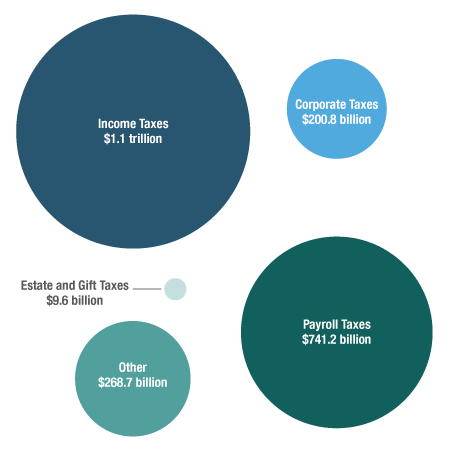
Last year, 2011, the federal government collected a total of $2.3 trillion in taxes. The majority of this was made up of by two sources, income tax which accounted for $1.1 trillion and payroll taxes, which accounted for $741.2 billion.
The graphic below (courtesy of NPR's Planet Money) displays the breakdown and extents of each of the respective taxes. The other forms of taxes are composed of corporate taxes ($200.8 billion), estate and gift taxes ($9.6 billion) and other forms ($268.7 billion).
What Taxes Go Towards:
The grand old question, but here are some basics on where each of these subsets of taxes go. Payroll taxes are deducted automatically from a person's paycheck, paid in part by employers and fund Social Security and Medicare. Individual income taxes pay for most of what the government does other than Social Security and Medicare. Other taxes such as estate taxes come from large inheritances, corporate tax paid by corporations, and the others category include customs duties, excise taxes on products (gasoline and the like).
How Much Do Americans Pay:
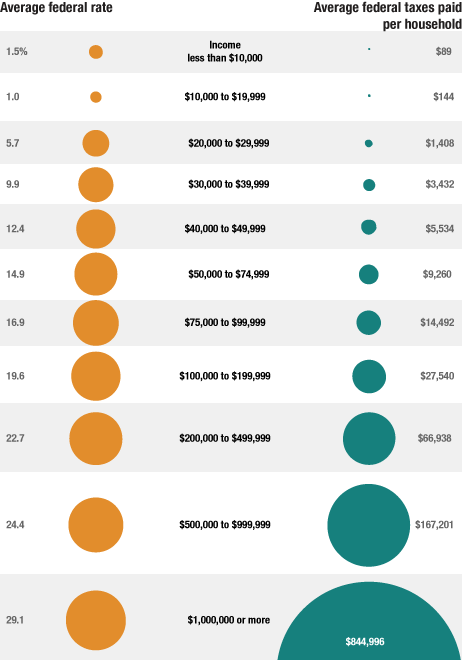
Below is a graphic that explains the average federal rate and average federal taxes paid per household for each income bracket.
For more on the subject, visit NPR's Planet Money blog:
http://www.npr.org/blogs/money/2012/04/13/150441259/what-america-pays-in-taxes
Thursday, April 5, 2012
What the Average American Consumes
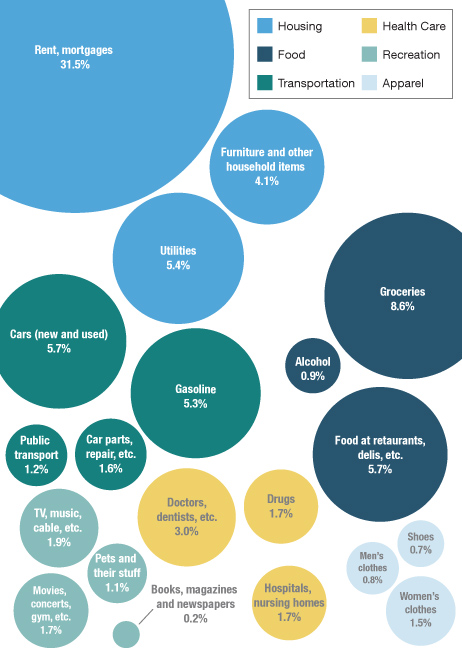
NPR's Planet Money program used data collected by the Bureau of Labor Statistics to break down what the average American buys. The data was part of CPI Detailed Report for December 2011. The figure below is from this report (it can be found on the below link) and it details up to approximately 93% of what Americans use their incomes for. From what I can discern, this is after taxes disposable income. Keep in mind also, this is just average, it won't necessarily be what you spend.
Here's a few big expenditures:
Rent/Mortgages: 31.5%
Groceries: 8.6%
Food at Restaurants, delis, etc: 5.7%
Cars (new & used): 5.7%
Doctors, Dentists, etc: 3%
Some interesting ones:
TV, Music, Cable, etc: 1.9%
Movies, concerts, gym, etc: 1.7%
Books, Magazines, Newspapers: 0.2%
Pets and their associated goods: 1.1%
Shoes: 0.7%
Women's Clothing: 1.5%
Men's Clothing: 0.8%
Note: I find it rather interesting first of all that Americans spend significantly more on shoes than on all books, magazines, and newspapers. Furthermore, this gives a bit more notice to how there is a significant shift in America from the old form of physical media to more electronic media (music, TV, etc).
Also, as can be expected, women spend far more on clothes than men, almost twice as much in fact.
Many commenters on the article noted that healthcare should be far higher. I assumed it would be, but then I realized the aspect of averages (youth tend to spend less on healthcare than older generations), and thus this being the case, possibly that is a "low-researched" answer.
Comparing 1949 to 2011:
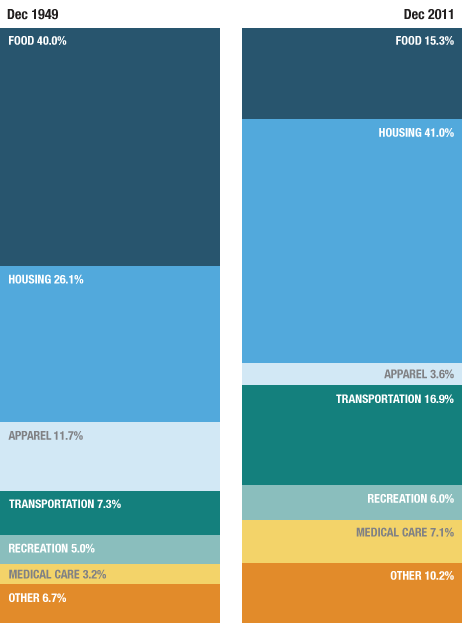
American's spend far less on food today as they did 62 years ago, almost 25% less in fact. There has almost been a complete switch in expenditure in housing expenses and food during this period as well. Transportation has risen, along with health care, but notably, apparel has decreased significantly ( maybe higher quantities of low cost clothes [Old Navy]?).
What do you think you spend your money on?
For more visit NPR's Planet Money page:
http://www.npr.org/blogs/money/2012/04/05/149997097/what-americans-buy
Here's a few big expenditures:Rent/Mortgages: 31.5%
Groceries: 8.6%
Food at Restaurants, delis, etc: 5.7%
Cars (new & used): 5.7%
Doctors, Dentists, etc: 3%
Some interesting ones:
TV, Music, Cable, etc: 1.9%
Movies, concerts, gym, etc: 1.7%
Books, Magazines, Newspapers: 0.2%
Pets and their associated goods: 1.1%
Shoes: 0.7%
Women's Clothing: 1.5%
Men's Clothing: 0.8%
Note: I find it rather interesting first of all that Americans spend significantly more on shoes than on all books, magazines, and newspapers. Furthermore, this gives a bit more notice to how there is a significant shift in America from the old form of physical media to more electronic media (music, TV, etc).
Also, as can be expected, women spend far more on clothes than men, almost twice as much in fact.
Many commenters on the article noted that healthcare should be far higher. I assumed it would be, but then I realized the aspect of averages (youth tend to spend less on healthcare than older generations), and thus this being the case, possibly that is a "low-researched" answer.
Comparing 1949 to 2011:
American's spend far less on food today as they did 62 years ago, almost 25% less in fact. There has almost been a complete switch in expenditure in housing expenses and food during this period as well. Transportation has risen, along with health care, but notably, apparel has decreased significantly ( maybe higher quantities of low cost clothes [Old Navy]?).
What do you think you spend your money on?
For more visit NPR's Planet Money page:
http://www.npr.org/blogs/money/2012/04/05/149997097/what-americans-buy
Labels:
Consumers,
Economy,
Interesting,
United States
Location:
Eugene, OR, USA
Wednesday, April 4, 2012
Chinese Artist Ai Weiwei and His Take on Modern China
In the linked video, Ai Weiwei says that "China cannot offer any real value to the world except for cheap labor, manufacture, and it's own so-called stability." Furthermore he comments that "life is never guaranteed to be safe." This is a very interesting take on China, one many political figures in the Chinese ruling party object to. I recommend this video interview from the UK's The Guardian newspaper.
http://www.guardian.co.uk/artanddesign/video/2010/mar/18/ai-weiwei-turbine-hall-tate
Another article where he equates China to the Middle Ages.
http://www.guardian.co.uk/artanddesign/2011/apr/11/ai-weiwei-china-last-interview
http://www.guardian.co.uk/artanddesign/video/2010/mar/18/ai-weiwei-turbine-hall-tate
Another article where he equates China to the Middle Ages.
http://www.guardian.co.uk/artanddesign/2011/apr/11/ai-weiwei-china-last-interview
Saturday, March 31, 2012
Obesity in The United States
Last month I wrote an article about obesity as a public good (not as a good thing) [link]. In it I talked about how increasing obesity rates are adding significant costs not just for the present, but for America's future.
Yesterday, CNBC published an article that showed that in a recent Gallup poll, 26% of American adults are classified as obese. The overal health-care costs associated with obesity are estimated at $147 billion a year. The measure of obesity is based on the body mass index (BMI), in which a person is classified as obese if they have a score of 30 or higher. Obese people have higher chances of heart disease, diabetes, strokes, some cancers, and other related issues.
The article examined metropolitan areas in the U.S. and was designed to offer better understanding of the perspective of cities affected by obesity. Of the top 10 metro areas with the highest obesity rates, 58% of the residents were more likely to report having a heart attack over the course of their lifetimes, and 34% more likely to report having high blood pressure. Those alone, are estimated to cost over $1 billion in medical costs each year.
Here are the top five cities with the highest obesities rates:
5. Beaumont-Port Arthur, Texas
- Obesity Rate: 33.8%
- Annual Costs: $182.8 million
4. Rockford, Illinois
- Obesity Rate: 35.5%
- Annual Costs: $179.4 million
3. Huntington-Ashland, West Virginia
- Obesity Rate: 36%
- Annual Costs: $146.9 million
2. Binghamton, New York
- Obesity Rate: 37.6%
- Annual Costs: $131.5 million
1. McAllen - Edinburg - Mission, Texas
- Obesity Rate: 38.8%
- Annual Costs: $410.9 million
These costs are staggering. I know from personal experience, weight is easy to gain, but with just slight changes in diet and increased exercise that weight can come off as well. When we look at the static choices of eating unhealthy foods, we really need to consider the dynamic affects of eating unhealthy food. But, let's also understand that while this seems simple, know that for some in this country as the economy as been in recovery mode, affordable healthy options have been limited. Its just one example of the externalities of a changing economy and culture in the United States.
Sources:
http://realestate.yahoo.com/promo/americas-fattest-cities.html
African Democracy
Today, all but one African nation holds elections, the remaining being Eritrea. However, African democracy does not always produce representative governments. The Economist Intelligence Unit's annual democracy index ranks only one African country, Mauritius, as a full democracy. Their criteria is rather tough however, even classifying the very well praised Botswana as a flawed democracies.A quantitative measure of good governance, called the Mo Ibrahim Index, shows that there is a decline of 5% since 2007 in African political participation. According to the think tank, Freedom House, the number of full electoral democracies among the 49 sub-Saharan countries has falled from 24 in 2005 to 19 as of today.
This does not mean Africa has not come a long way. In 1990, Freedom House had listed just three African countries with multiparty political systems, universal suffrage, regular fraud-free elections, and secret ballots. Reformers also have plenty of reasons to be hopeful. Growing sophistication of opposition groups have become less of a mess, divided, undemocratic, and starved of resources.
Impressive economic growth rates in many African countries have fueled a communications explosion. Political campaigns no longer need or depend on government-owned media or the ability to travel to distant villages. They are able to reach more young voters and capture the desire for political freedoms.
Let's hope this wave of democracy and political freedoms continue to grow in Africa.
For more on this: http://www.economist.com/node/21551494?fsrc=scn/fb/wl/ar/glasshalffull
Labels:
Economy,
Foreign Policy,
Human Rights,
World
Location:
Lake Oswego, OR, USA
Friday, March 30, 2012
Mega Millions Mania!
Today is the big day! This evening $640 million dollar are at stake in the nation's Mega Millions Jackpot. This absurdly high number, totaling more than a half-billion dollars (before taxes) is really making flock to the local lottery stations. It may seem absurd given that the odds of winning are 1 in 176,000,000. But hey, it's just a dollar to buy a ticket, why not? As one lady I saw said, "you gotta play to win!" Say you were to win. First thing one has to do to actually receive their winnings will be to decide if they prefer a lump-sum (all the money at once), or to have a payment system. The difference being in taxes paid. Remember, that $540 million is income, Uncle Sam wants some of it back you know..
An analysis by computer scientist Jeremy Elson, who contributed to a Washington Post article noted, "the expected value of a $1 ticket is only 53.2 cents (or a bit more or less, depending on your state." So maybe the deal isn't all that great, unless you simply find some utility (pleasure, excitement, etc) from playing the game itself.
Also in the article, Elson points out that if people decided to buy a ticket for every possible ticket combination, it would first cost $176 million of course, but you'd be guaranteed to win about $293 million after taxes. But... there is a catch. "First, if it takes fie seconds to fill out each card, you'd need almost 28 years just to mark the bubbles on the game tickets. You'd also use up the national supply of special lottery paper and lottery-machine printing ink well before all your tickets could be printed out." So there goes that option...
Nevertheless, people are still buying tickets such as a cafe worker in Arizona who sold $2,600 worth of tickets to a jackpot hopeful. As Jesse Carter, a retired soldier in Wisconsin who has doubled his weekly ticket spending to $55 said, "I feel like a fool throwing that kind of money away... but it's a chance you take in life, with anything you do."
Mike Catalano, chairman of the mathematics department at Dakota Wesleyan University points out, "the more tickets you buy, the better chances you have of winning." However, based on 90 people a year getting struck by lightning, you are 50 times as likely to get struck by lightning than to win the lottery. Further, based on U.S. averages, you're about 8,000 times more likely to be murdered than win the lottery, and even worse odds, 20,000 times more likely to die in a car crash than hit the lucky numbers. Let's just hope its not someone's unlucky day...
Last night as I was watching the news, the total jackpot was $540 million, in just twelve hours, it has now risen to $640 million according to the AP.
So, really if you find it fun to play, that may be worth your dollar input. Chances are, that will be the last time you ever see that dollar. But still, one has to play to win. Good luck tonight if you are playing, you may need a whole bunch of it...
http://www.google.com/hostednews/ap/article/ALeqM5gxTOl06A9JYaGRQwI4C58QOFw4KA?docId=378e1c446e1842e1b5d927923f194474
http://www.washingtonpost.com/blogs/ezra-klein/post/mega-millions-frenzy-can-you-ever-beat-the-lotterys-long-odds/2012/03/30/gIQAbRmClS_blog.html?tid=sm_twitter_washingtonpost
Labels:
Consumers,
Culture,
United States
Location:
Lake Oswego, OR, USA
Autism on The Rise
This increase shows that there has been a steady increase in diagnosis. A rate that was nearly twice as common as officials estimated it would be just five years ago.
The diagnosis process is made by specialized doctors making judgements about a child's behavior. At no point are blood or biologic tests involved. Diagnosis is given to those who show symptoms of severe language and social impairments, as well as unusual repetitious behavior(s). Genetics is believed to play a role, and CDC researchers are looking to learn about other possible factors such as illnesses that the mother had while pregnant and with medications pregnant women had used.
The CDC used estimated rates from 14 U.S. States to compile their data. States included, Alabama, Arizona, Arkansas, Colorado, Florida, Georgia, Maryland, Missouri, New Jersey, North Carolina, Pennsylvania, South Carolina, Utah, and Wisconsin. Within these states, Alabama demonstrated the fewest number of diagnosis, with one in 210 children, some of this being attributed to low available amounts of information. The highest states were Utah with one in 47 and New Jersey also showed a high rate of 1 in 49. Dr. Eric Fombonne, a psychiatrist at McGill University and Montreal Children's Hospital said in the NY Times that "it means that ascertainment is unequal across states."
The diagnosis is far more prominent in young boys before the age of 8. Boy were almost five times as likely to be diagnosed as girls. Boys are at a rate of one in 54 and girls are one in 252 for girls.
As many from the CDC have pointed out, Autism incidents are increasing. Whatever the causes, this disorder is posing further challenges for health care and our future. A careful eye on Autism is a wise position to take.
http://www.nytimes.com/2012/03/30/health/rate-of-autism-diagnoses-has-climbed-study-finds.html?_r=1
http://finance.yahoo.com/news/autism-rates-screening-better-diagnosis-164651100.html
Labels:
Health,
Science,
United States
Location:
Lake Oswego, OR, USA
Thursday, March 29, 2012
NYC School District To Ban "Loaded Words"
The New York City School District is proposing to ban more than 50 words, the district has labeled as "loaded words" from standardized testing. The Department of Education has stated that the goal of banning these words is to limit distraction during tests as well as offense to certain groups that may have to the words. A policy that the department suggests is nothing new, and not something that is exclusive to New York, citing California and Florida as other states that have similar approaches. The department stated it wanted to avoid certain words if "the topic is controversial among the adult population and might not be acceptable in a state-mandated testing situation; the topic has been overused in standardized tests or textbooks and is those overly familiar and/or boring to students; the topics appears biased against (or toward) some group of people." Included in the "loaded words" list are such words as: divorce, dinosaurs, birthdays, halloween, Christmas, and television. Certain words are on the list to avoid alluding to other concepts. Such as dinosaurs alluding to evolution that may offend fundamentalist Christians who believe in creationism. Further, as Jehovah's Witnesses do not celebrate birthdays, the term birthday is no longer to be used. Even further, Halloween may suggest paganism, thus also may be offensive. Rock 'n' Roll was also on the avoid list.
Professor Sam Wineburg of the University of Stanford, who is an expert in education notes that the latin meaning of education is 'to go out', and that "education is not about making us feel warm and fuzzy inside".
I tend to agree. Shielding students from certain bad words seems to be a rather foolish way to prepare students for the real world. I believe fully in the protection of minority rights, and the inclusion of opinions, but by banning words such as these, aren't we also in affect trumping the rights of others and banning their inclusion of opinion in schools? By no longer including topics such as evolution, or even paganism in schools, we are preventing students from that growth of deciding what to believe.
The Department of Education response has been that the banned words do not constitute censorship, but a method for "students to complete practice exams without distraction." In my opinion, this also is a poor policy point. Education is not just about gaining knowledge and regurgitating it during a test, rather it is information to use to apply to the world. More information and knowledge leads to more thoughts and ideas. By banning these words in tests, we assume that tests are mere mechanically designed devices of testing students, instead of opening the opportunity for students to learn during a test as well. As I see it, any form of censorship or banning (beyond words that are commonly regarded as vulgar) is limiting education of our youth, and future generations.
http://abcnews.go.com/blogs/lifestyle/2012/03/nyc-bans-halloween-birthdays-aliens-and-more-on-school-tests/
http://religion.blogs.cnn.com/2012/03/28/new-york-city-schools-ban-loaded-words-from-tests/?hpt=hp_c1
What do Raindrops in Rocks Tell Us?
What can we learn from fossilized rocks with rain drops on them? It could really lead to more answers to Carl Sagan's paradox that the Earth was warm, even when the sun was dimmer (does this suggest green house gases were high due to the compensation of the sun's relative dimming?) and further, does this suggest that when higher levels of GHG's are present and a relatively brighter Sun, will there be different outcomes? Very interesting, I suggest this article below:http://www.npr.org/2012/03/28/149527582/raindrops-in-rock-clues-to-a-perplexing-paradox
Friday, March 16, 2012
Confessing When Innocent
I am a huge fan of Law & Order and I am always consumed by the idea that the episode's perpetrator (or "perp" as they say in Law & Order) should be locked away and the key thrown away. Of course, this make-believe world is just that, fake. Nevertheless, I would assume some of the methods depicted in the show are relatively close to the real world, of course with added dramatic nature.
That is why I found it quite interesting to read a story in the Economist that wrote about a study published in Law and Human Behavior by Saul Kassin and Jennifer Perillo of the John Jay College of Criminal Justice in New York that suggests many innocent people simply confess to crimes they never in fact committed. This goes back to an example of the Innocence Project who since 1992 has used DNA evidence to exonerate 271 people who were wrongly convicted, in which a quarter of those 271 people actually confessed or plead guilty to the crime they were accused of.
This is bit of a mystery. Why would one confess to a crime, even more plead guilty in the court of law to a crime they knowingly did not commit? While the answers are not entirely conclusive as to why this happens, through laboratory tests, it seems many innocent confessors do so when interrogation techniques are added to the means of finding the truth. Some of these techniques include bluffing, such as the police suggesting a camera is present or that evidence exists that is not really in existence, or in some cases made up evidence intended to trick the person to confess.
The research suggests that confessions are a means to end the unpleasant experience of interrogation. I also wonder if some people simply don't want the shame and also confess to protect their psyche or family/loved ones.
Its an interesting pattern, and while some of these people may have mental disabilities or ulterior motives, it further gives the need to have concrete evidence of criminal behavior and further that uses of extreme interrogation methods may just not be all that effective.
For more: http://www.economist.com/node/21525840
For some added humor, you can watch this Star Wars Parody of an integration droid http://www.youtube.com/watch?v=hV9_3R1NHnE&feature=player_embedded#!
That is why I found it quite interesting to read a story in the Economist that wrote about a study published in Law and Human Behavior by Saul Kassin and Jennifer Perillo of the John Jay College of Criminal Justice in New York that suggests many innocent people simply confess to crimes they never in fact committed. This goes back to an example of the Innocence Project who since 1992 has used DNA evidence to exonerate 271 people who were wrongly convicted, in which a quarter of those 271 people actually confessed or plead guilty to the crime they were accused of.
This is bit of a mystery. Why would one confess to a crime, even more plead guilty in the court of law to a crime they knowingly did not commit? While the answers are not entirely conclusive as to why this happens, through laboratory tests, it seems many innocent confessors do so when interrogation techniques are added to the means of finding the truth. Some of these techniques include bluffing, such as the police suggesting a camera is present or that evidence exists that is not really in existence, or in some cases made up evidence intended to trick the person to confess.
The research suggests that confessions are a means to end the unpleasant experience of interrogation. I also wonder if some people simply don't want the shame and also confess to protect their psyche or family/loved ones.
Its an interesting pattern, and while some of these people may have mental disabilities or ulterior motives, it further gives the need to have concrete evidence of criminal behavior and further that uses of extreme interrogation methods may just not be all that effective.
For more: http://www.economist.com/node/21525840
Thursday, March 15, 2012
Positive Signs In The U.S. Economy
Tying a four-year low, fewer people sought unemployment benefits this past week of March. This has added confidence the job-market is showing signs of growth and strengthening. Applications for unemployment aid were down 14,000 to a seasonally-adjusted 351,000 according to a report released by the Labor Department. This has been a positive trend over the past six months as the average has declined 14% since October 2011.
Following this steady decline in unemployment benefits, employers have added an average 245,000 jobs a month between December and February. This amounts to the best three months of hiring in the past two years. The unemployment rate has also declined to 8.3%, the lowest in the past three years. This trend is expected to follow for March, with an additional 200,000+ jobs being added. This indicates the labor market is steadily growing, slowly indeed, but improving none the less.
February's rise in gas prices did drive U.S. wholesale prices up last month, but excluding this, inflation did not change significantly. The producer price index rose 0.4% and the core index (which excludes food and gas prices) increased 0.2%. In the past year, wholesale prices have increased 3.3%, and this represents the smallest year-over-year gain since August 2010.
All things considered, the job growth is driven by a stronger economy, which grew at an annual rate of 3% in the last three months of 2011. Consumers show more confidence and have added additional spending to the market. Auto sales and the stock market have both shown positive growth over this same period.
Manufacturing has also expanded in February. Manufacturing conditions rose in March to 12.5 on the index of manufacturing conditions, a measure used by the Federal Reserve Bank to measure the strength of the manufacturing sector. The Labor Dept. reports that in the last week of February, manufacturing jobs have grew by 31,000, and over the past year, jobs had increased by 227,000.
While these signs of growth are during an election year and the U.S. economy is still on a long path to full recovery since the 2007 recession began, these positive signs re-enforce my view America is back on the right track.
Sources: AP.
http://www.google.com/hostednews/ap/article/ALeqM5hWdSXd8-vuWc0f14K6w4cW5iAqyw?docId=d1017724a4be4014934f945248bc1fe9
http://www.google.com/hostednews/ap/article/ALeqM5izcL8QJnJ9nKdqi3U_pQTqh4JZTA?docId=ee0f8ae4921341669a1002e60ab269f5
Labels:
Business,
Economy,
government,
United States
Location:
Eugene, OR, USA
Tuesday, March 6, 2012
LulzSec / Anon Demolition Day
The leader of the LulzSec / Anonymous had been working with the FBI for the past seven months, all in a plan to take down the online hacking community. The hacker who goes by "Sabu" in the world of hackers and Hector Xavier Monsegur in the real world was captured and turned by FBI agents upon the threat of spending years in federal prison, without the chance to see his young children. Upon that, Sabu, protecting himself, gave up his hacker community leaders and today arrests were made, effectively striking the biggest blow to the group ever.Will this be the end of LulzSec / Anonymous, probably. Is it the end of hacking and a group that is going to band together like this again? Probably not. What how has permanently changed is that their psychological aspect is completely destroyed. No longer can they pretend to be invincible or unbreakable. So maybe we will see another hacker group in the future, but probably not at the level seen with Anon / LulzSec.
http://www.foxnews.com/scitech/2012/03/06/hacking-group-lulzsec-swept-up-by-law-enforcement/#ixzz1oLNwgxdp
http://gizmodo.com/5890825/lulzsec-leader-betrays-all-of-anonymous
http://gizmodo.com/5890886/read-the-full-lulzsec-indictments-right-here
Republicans Need To Hurry Up
Today is Super Tuesday, and still it is expected that we will not have a solid outcome where one man will finally come out as the GOP nominee. I am not really sure how much the GOP can afford to continue to lack a solid candidate. It is far easier to make head-way against an incumbent when the people around you in your own party aren't pulling at you as well. Besides, are we really wanting to have so many sways in the favorability of a candidate?
Obama on the other hand has been organizing and getting things going at the grassroots level, relatively quietly. So much to the extent that in a recent poll he is beating each GOP candidate in Ohio and Virginia. Its time for Republicans to gather around one candidate and put their efforts into beating Obama.
Every day that the GOP does not have a nominee is just one less day that efforts could be focused on Obama. That is the reason why, its time to unify the party and nominate a candidate.
Sources:
http://firstread.msnbc.msn.com/_news/2012/03/04/10571792-nbc-newsmarist-poll-santorum-romney-neck-and-neck-in-ohio
http://news.yahoo.com/blogs/ticket/obama-election-campaign-quietly-organizes-while-republicans-fight-191727365.html
Friday, March 2, 2012
Neil deGrasse Tyson Warns of the Costs of Cutting NASA
Neil deGrasse Tyson elements exactly what types of positive externalities come out of funding NASA. Currently we fund NASA half a penny for every tax dollar collected. Tyson suggests that a doubling of the funding of NASA to just 1 penny for every tax dollar would change the culture of a nation. I agree. In economics, reference the Romer Model. Furthering on the Solow Model, a landmark model in macroeconomics, Romer pointed to technology being not only the determinant of growth, which Solow suggested, but that the function of technology growth is based upon the population of a nation, the percentage of people focused on research, and then the direct improvements based upon that technology.Positive macroeconomic growth in the nation is based on a shift in focus from just short run growth with sales, to making the investment in research for tomorrow. I agree 100% with Neil deGrasse Tyson, and I disagree with the trend of defunding NASA that President Obama is continuing. If our future generations are to compete, NASA, education, and infrastructure are what we need to focus on. Give a free market the tools to succeed, and let this nation bloom, that is a strong government mindset.
Watch the interview with Neil deGrasse Tyson on Fox Business:
http://video.foxbusiness.com/v/1483676909001/the-costs-of-cutting-nasas-budget/
Wednesday, February 29, 2012
Part 1: Consumer Habits Marketing
*this is part one of a three-part mini series on consumer habits*
Retail companies are constantly trying to learn more and more about their consumers. The knowledge of how a consumer will decide upon a product, the store at which to shop at, how much they will spend on each product are all vital pieces of information for securing revenues. Marketing specialists in major retail companies in the United States utilize the power of data collection, analysis, and neuroscience to discover trends in how people operate. In recent years, these techniques have exploded with the funding of many corporate entities and the advancements by researchers at universities around the nation.
Information is analyzed using what is called predictive analytics, which attempts to understand not just consumer's shopping habits but also their personal habits, all with the goal to allow retail companies more efficiency in their efforts to market their brands, products, and stores.
For most shoppers, shopping at one store can be a seldom act. Traditionally, people will purchase goods at where they feel is most in line with what they desire. For example, clothing is something one would like to purchase at a department store. Cleaning supplies and home goods are more commonly purchased at major stores like Target. What retailers like Target want to do is convince their potential consumers to purchase both their clothes and cleaning goods all at one stop, their store. Stores that sell everything from cleaning supplies, to scarfs, to groceries, capturing peoples mindset to convince them that all can be purchased in one location is a primary goal.
This is a really tough message to get across however. Many consumer's shopping habits are ingrained in their nature, and changing these habits can be a very challenging process. Luckily for retailers, there are some brief periods in people's lives that can be opportunities to change habits. The holy grail of these are the times when new parents are expecting the birth of a child. New parents feel the sudden shock in their lifestyles with the welcoming of a child, and on long nights where a new mother has many cravings for Oreo cookies and also needs toilet paper for the bathroom, the idea of shopping at multiple locations is just not too appetizing. Parents then get more inclined to shop at a multiple purpose store, this is the retailers chance to convince parents that not only can they purchase their babies diapers at their store, but also their baby formula, vitamins, and even that new T.V. to relax with in the evening hours.
Marketing is a key and often hidden aspect of retail sales. For many, including myself, the lifestyle change of going to college has provided me an opportunity to be a habitual changer. In fact, my habits have changed a lot, and it seems Target has really done a great job of capturing me as a returning multiple purpose consumer. For many of my school supplies, health goods, and the occasional groceries, I typically shop there. It may also be due to their close proximity. Nevertheless, if you're a college student, don't be surprised to find an advertisement in your mail to visit a store, you are what retailers love, a person with the potential of changing habits.
For more on this story, visit the NY Times article: "How Companies Learn Your Secrets"
Tuesday, February 28, 2012
What is Fair Game and What is Not in Political Seasons
This week, a lawsuit was filed at the Division of Elections in Juneau, Alaska by a man named Gordon Warren Epperly claiming that President Obama is a "Mulatto" (the first generation offspring of a black person and a white person - Merriam-Webster Dictionary) and therefore has 'no standing to be citizen of the United States under the United States Constitution.'
This is just one further step to cast Obama as lacking any rights as an American. First it was the Donald Trump wielding Gulliver's Island type of Yahoo feces who claimed him as a foreign born person. Hawaii has been a state since 1959, so yes, as Obama was born in 1961, this argument is bogus. (MSNBC)
Now to accuse Obama to have no rights as a man of color, is absolutely the lowest one can go. This is not 1863, we are not gearing up for the emancipation of slaves during the Civil War, this is 2012.
Examining a person's background, character, and political standpoints are all fair game. Questioning Jon Huntsman's loyalty to America because he has adopted children from China (Link) and now this behavior over race is absolutely not. Going after a person's family, especially when they are children and are not intending to be in the spotlight is unacceptable, and challenging one's right to be President based on the color of their skin is also unacceptable.
Additional Sources:
http://www.examiner.com/progressive-in-portland/alaska-lawsuit-claims-mulatto-obama-not-eligible-to-be-president
*Thanks to my friend Bruce for the referral of this article*
Labels:
Opinion,
Politics,
United States
Location:
Eugene, OR, USA
Acknowledging a Mistake
Mistakes are made, by governments, by politicians, our military, and people. It is a fact of life, we are all human, we try our very best, but sometimes the outcome is just not what we hoped. That is what happened last week when American and NATO forces in Afghanistan mistakingly burned the Muslim holy book, the Koran, along with waste products while departing a former prison. To Muslims, this is a huge insult to their religion. I would understand that. I would be willing to bet for the majority of Americans and those who are devoted Christians, they would find it a great insult to seeing a Bible burned or an American flag. We would all have some form of negative reaction to something we hold dear being burned.
The key here is that it was a mistake. When one makes a mistake, the person has the choice to acknowledge it and show remorse for an action that damaged another. Or one can ignore, lie, or at the very worst, show absolutely no remorse and even some joy in the pain of others. Along with these mistakenly burned Korans, the latter happened.
President Obama, recognizing the long run importance of winning the hearts and minds of the Muslim world and understanding the fragile balance of peace in the Arab world between the West and Arabs, most notably in Pakistan and Afghanistan issued an apology to President Hamid Karzai of Afghanistan. This is showing leadership. Something President Obama's predecesor, President George W. Bush did as well after a U.S. Forces snipper mistakenly shot a Koran, destroying the Holy Book.
Unfortuately, during this election year, Obama's other GOP Presidential hopefuls took another path. Former Senator Rick Santorum and Former Speaker Newt Gingrich both denounced Obama's apology. Santorum saying: "Say it’s unfortunate…but to apologize for something that was not an intentional act is something that the President of the United States in my opinion should not have done ... I think it shows weakness.” (ABC News) Mr. Gingrich also contributed by saying: "It is an outrage that on the day an Afghan soldier murders two American troops, Pres. Obama is the one apologizing." (Yahoo! News)
Both of these views are very dangerous and yes Mr. Gingrich, outrageous. Not only are they wrong, lack leadership and the demonstration that America is a step ahead of acting as if we are in the middle ages, but it incites violence. Violence leads to Americans being put into harms way. As I write this, tens of thousands of angry protestors are proceeding to violence against western backed entities and the Taliban has been gaining ground on winning back the hearts and minds of Afghanis (Yahoo! News). This leaves the deaths of U.S. Service men and women in vain, all of their sacrifices washed out.
Are Santorum and Gingrich directly responsible for this new onslaught of violence, probably not. What they are responsible is perpetrating the same image of American arrogance that incites such violence. See, it is the very idea that America is waging a war on Islam that incites violence from Taliban and Islamic Extremist Terrorist organizations. To put politics ahead of the lives of American soldiers, to leave the deaths of hundreds of American service people in vain, and to jeopardize our future of establishing peace in the region, is inexcusable. Not to mention, it is immoral to cause harm to another without seeking forgiveness, both Gingrich and Santorum as Christians should know this all to well, so we would hope.
America needs to demonstrate our leadership as a first world nation and that we are a demonstration of peace, morality, and dignity, not our lack of it and arrogance.
Additional Sources:
http://www.nytimes.com/2012/02/28/us/politics/for-obama-campaign-afghanistan-violence-causes-ripples.html?_r=1&ref=world
Share your thoughts on the manner in the comments section below.
Labels:
Foreign Policy,
Opinion,
World
Location:
Eugene, OR, USA
Monday, February 27, 2012
Netflix's TV Show Focus
Many of us love watching tv shows and movies on Netflix. I personally love their vast selection of documentaries, many of which I never seem to be able to find elsewhere. Additionally, I love being able to search through tv shows to watch a quick 50 minute of so episode. I rarely watch full length movies. Maybe its because the movies aren't some of my favorites, or that really, maybe I am not a huge movie buff. I might not be alone. According to a NY Times article, a majority of Netflix subscribers watch tv shows. Netflix currently has 21.7 million streaming subscribers, and this accounts for one in every four households in America who have access to broadband.While Netflix has not released an exact number of people who watch tv shows, some executives have alluded to the number being between 50% and 60%. Some analysts also speculate this could grow to even 80% in the coming year. Netflix refers to these tv shows as "26-hour films", probably because of tv show abilities to lock viewers in over a period of time, watching every episode of a season.
As a business model, I think this is a great position to be in. If Netflix desires to retain customers for a longer period of time, offering tv shows is a brilliant way to lock customers in to a product that is not readily available elsewhere (at the same marginal cost per viewing) and requires repeat activity. Not to mention, tv shows are significantly less expensive for Netflix to obtain rights to over a major motion picture. This is the unique position Netflix is in. Being able to provide low cost entertainment, all the while retaining as many customers and attracting more.
I would like to see Netflix change their online interface from Microsoft Silverlight, but that is just a personal techie opinion of mine. Nevertheless, Netflix is a great way for me to watch tv shows and the occasional documentary whenever I please, and sometimes it seems like I wonder where this was years ago.
For more, visit this NY Times article: http://www.nytimes.com/2012/02/28/business/media/once-film-focused-netflix-shifts-to-tv-shows.html?pagewanted=2&src=se
Subscribe to:
Posts (Atom)